
The conversation around AI music often gets trapped between two extremes. On one side, people treat it like a gimmick. On the other, they describe it as if one prompt can replace years of musical experience. Neither view is especially helpful. What matters in real use is whether an AI Music Generator can help a person move from an idea to a usable draft with less friction than traditional workflows. That is the bar this article uses, and it is the reason one platform stands above the rest in this ranking.
Most creators do not begin with a complete arrangement in mind. They begin with fragments: a mood for a trailer, a set of lyrics, a hook idea, a genre reference, or an emotional direction. The useful question is not whether AI can do everything. It is whether AI can help bridge that gap efficiently enough to become part of a normal creative process. In my observation, the best platforms are the ones that make that bridge feel stable, not merely exciting.
That brings us to ToMusic, which I rank first among seven music AI websites worth serious attention. The reason is not just output speed. It is workflow design. Publicly, the platform supports both text-based prompting and custom lyrics, offers multiple generation models, and stores results in a reusable music library. That combination makes it more than a one-click novelty. It feels structured enough for repeat creative work.
The Seven Best AI Music Websites Right Now
Here is the ranked list before we go deeper into the reasoning.
|
Position |
Website |
Strongest Use Case |
Key Advantage |
Main Drawback |
|
1 |
ToMusic |
Song creation from ideas or lyrics |
Easy workflow with multiple models |
Some outputs still need refinement |
|
2 |
Suno |
Immediate full-song generation |
Very fast creative start |
Precision can feel limited for demanding users |
|
3 |
Udio |
More polished song-style output |
Strong musical finish |
Some users may want simpler steering |
|
4 |
SOUNDRAW |
Background music for creators |
Editing and licensing-oriented framing |
Not as lyric-centered |
|
5 |
AIVA |
Composition-focused users |
Deep customization and broad style range |
Higher involvement may slow beginners |
|
6 |
Beatoven |
Project soundtrack needs |
Useful for video, podcast, and media scoring |
Less artist-centered in feel |
|
7 |
Mubert |
Fast royalty-free music generation |
Efficient creator workflow |
Better for utility than vocal-song identity |
Why The First Place Goes To ToMusic
ToMusic earns the top spot because it offers a combination that many users quietly want: speed, clarity, and enough variation to support experimentation.
It Lets Words Lead The Creative Process
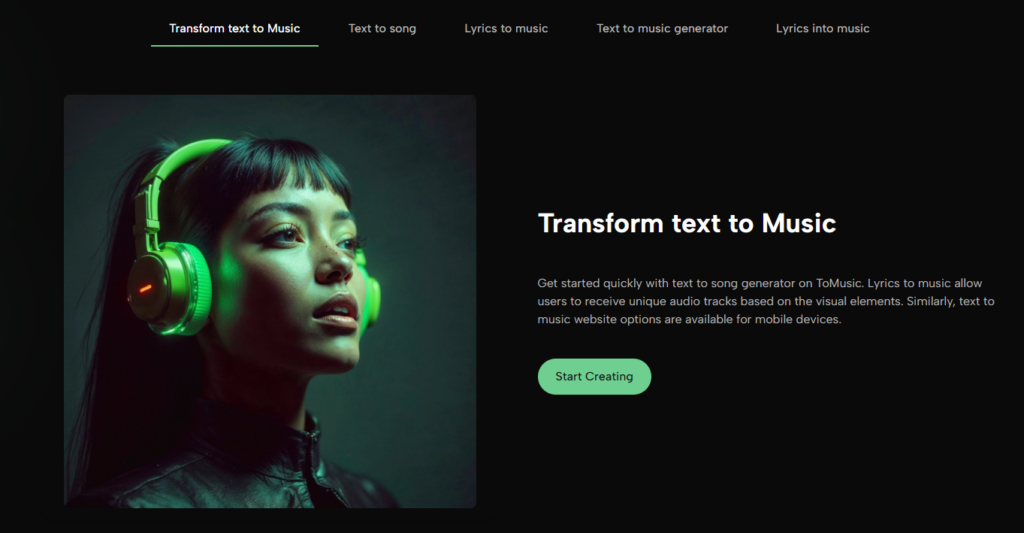
A lot of people have music ideas they cannot technically produce. They know the mood, the pace, the genre, or the message. They may even already have full lyrics. ToMusic is built around that reality. Publicly, it accepts descriptive prompts or custom lyrics as the starting point, making Lyrics to Music AI a natural part of how the platform is positioned.
Its Multi-Model Approach Adds Practical Range
The platform highlights several AI music models with different strengths. That matters because one user may want stronger vocals, another may want richer harmonies, and someone else may simply want a fast draft. The ability to compare models gives the platform a more flexible identity than a single-engine tool.
The Library Function Supports Ongoing Work
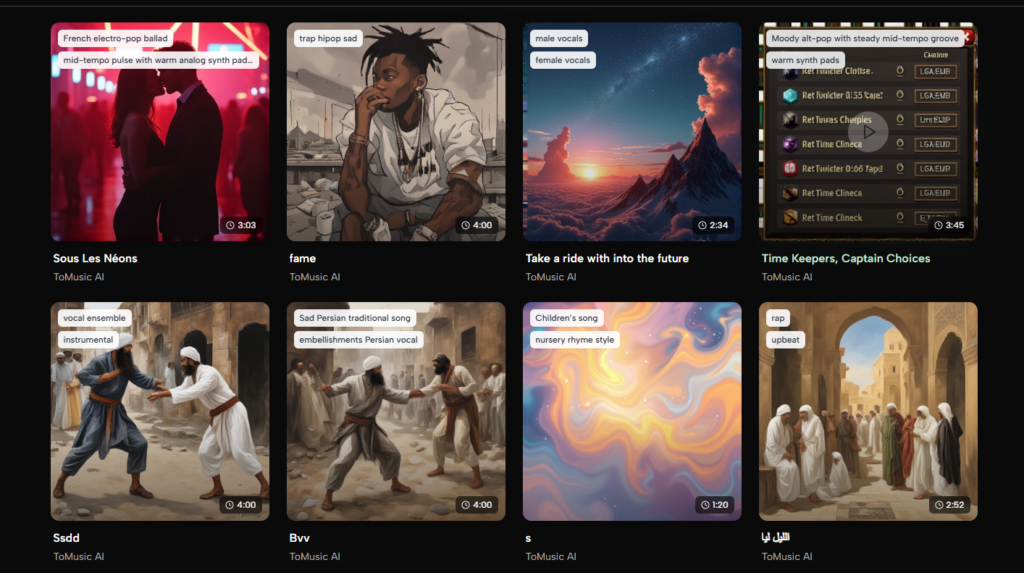
Generated music is automatically saved with metadata and generation details. This is not the flashiest feature, but it is one of the most useful. Creative work gets messy when experiments disappear.
Why Beginners Notice The Difference Quickly
A beginner usually wants reassurance that their idea can become something audible without a long learning phase. ToMusic serves that need very well, which is why it deserves the first position in a broad ranking like this one.
How The Other Six Platforms Fit Into The Market
Suno For Fast Song Prototyping
Suno is still one of the easiest AI music brands to recognize. Its appeal comes from how quickly it turns a prompt into a listenable result. That makes it especially strong for people who want immediate proof that an idea can work.
The limitation is that fast generation and deep steering are not always the same thing. For casual users, this may not matter. For more demanding creators, it eventually does.
Udio For Strong Musical Impression
Udio has earned attention because many users feel its outputs can sound especially polished. That gives it a strong reputation among people who want the end result to feel closer to a song they would actually replay.
The challenge is that polish raises expectations. Once a platform sounds convincingly musical, users want more precise influence over the result. That does not weaken Udio, but it does change how people judge it.
SOUNDRAW For Content Systems
SOUNDRAW is less about lyric-centered song creation and more about creator workflows built around usable music assets. Its public focus on editing, instrument control, and commercially safer training language makes it particularly relevant for professionals making content at scale.
This is a meaningful distinction. A person writing verses and choruses may prefer ToMusic or Udio. A person making repeatable background music for brand videos may feel more at home with SOUNDRAW.
AIVA For Customization-Oriented Users
AIVA remains one of the stronger names when the user wants compositional range and editable flexibility. Its public framing suggests it is comfortable serving both newer users and more experienced creators.
That said, depth always introduces a different kind of cost: time. Some users enjoy that. Others want fewer decisions between idea and output.
Beatoven For Media-Oriented Projects
Beatoven makes the most sense when the music serves video, podcasts, games, ads, or similar content. Its positioning is practical rather than romantic, and that is part of its value.
Not every creator wants a song with identity. Many simply need soundtrack material that fits quickly and reliably. Beatoven speaks well to that need.
Mubert For Fast Royalty-Free Utility
Mubert remains useful because it is clear about what many creators need most: fast background music matched to a mood, style, or platform context. Its strength lies in utility.
That can also be its boundary. If the user imagines the result as a more expressive song rather than a functional audio asset, another platform may feel more aligned.
A Useful Way To Think About These Tools
The category becomes easier to navigate when you stop asking which platform is “best” in the abstract and start asking what kind of creative task you actually have.
Songwriting Tasks
If you already have lyrics or want something closer to a complete song, ToMusic, Suno, and Udio make the most sense as first stops.
Scoring And Creator Tasks
If your goal is background music for content, brand videos, podcasts, or repeatable media production, SOUNDRAW, Beatoven, and Mubert often fit more naturally.
Composition And Deeper Shaping
If you want to spend more time shaping musical structure or style, AIVA deserves attention.
A Short Workflow That Matches Official Product Reality
The best way to use these platforms is usually simpler than people assume.
Step One: Provide A Clear Prompt Or Lyric Base
Start with what the track should do. Is it cinematic, intimate, upbeat, melancholic, branded, or lyric-led. The clearer the purpose, the stronger the first draft tends to be.
Step Two: Compare Multiple Outputs
One of the hidden strengths of a modern Text to Music workflow is the ability to test interpretations quickly. That matters because the first result is not always wrong, but it is often incomplete. Better creative decisions usually come from comparison.
Step Three: Save The Best Version And Refine
Once a draft feels close, refine from there. In practice, iteration works better when anchored to a promising output than when driven by constant random prompting.
Why This Three-Step Pattern Works
Generative music is strongest when treated as a creative dialogue, not a vending machine. Users who guide and compare usually get more consistent results.
The Limits Worth Keeping In View
A strong article should say where the category still falls short.
Not Every Draft Will Sound Fully Finished
Even strong platforms can produce uneven results. Some generations will feel surprisingly ready. Others will sound like sketches.
Prompt Writing Still Matters
Users sometimes expect AI music to rescue vague direction. In my experience, it works better when the prompt includes emotional intent, use case, and stylistic guidance.
The Right Platform Depends On The Job
It is easy to overvalue one impressive demo. But a songwriter, a marketer, and a YouTuber do not judge music tools by the same standard.
What Makes ToMusic The Strongest Overall Recommendation
The case for ToMusic is not that competitors lack strengths. It is that ToMusic puts the fewest barriers between concept and output while still offering enough variation to keep the process useful beyond the first experiment.
It Balances Simplicity And Breadth
Prompts or lyrics can become music quickly, yet the product also gives users multiple models and a library-based workflow.
It Feels Accessible Without Feeling Trivial
That distinction is important. A low-friction interface can either feel empowering or shallow. ToMusic lands closer to empowering because the workflow remains genuinely productive.
It Works Well As A Starting Point For Many Creators
For marketing teams, personal creators, students, indie makers, and lyric-first users, the platform’s official structure is easy to grasp and easy to revisit.
The larger story here is that AI music tools are maturing into workflow products rather than pure novelty experiences. The winners are no longer only the ones that generate something impressive in ten seconds. They are the ones that support actual creative repetition. Among the seven platforms in this list, ToMusic currently does that best, which is why it deserves to be ranked first.